
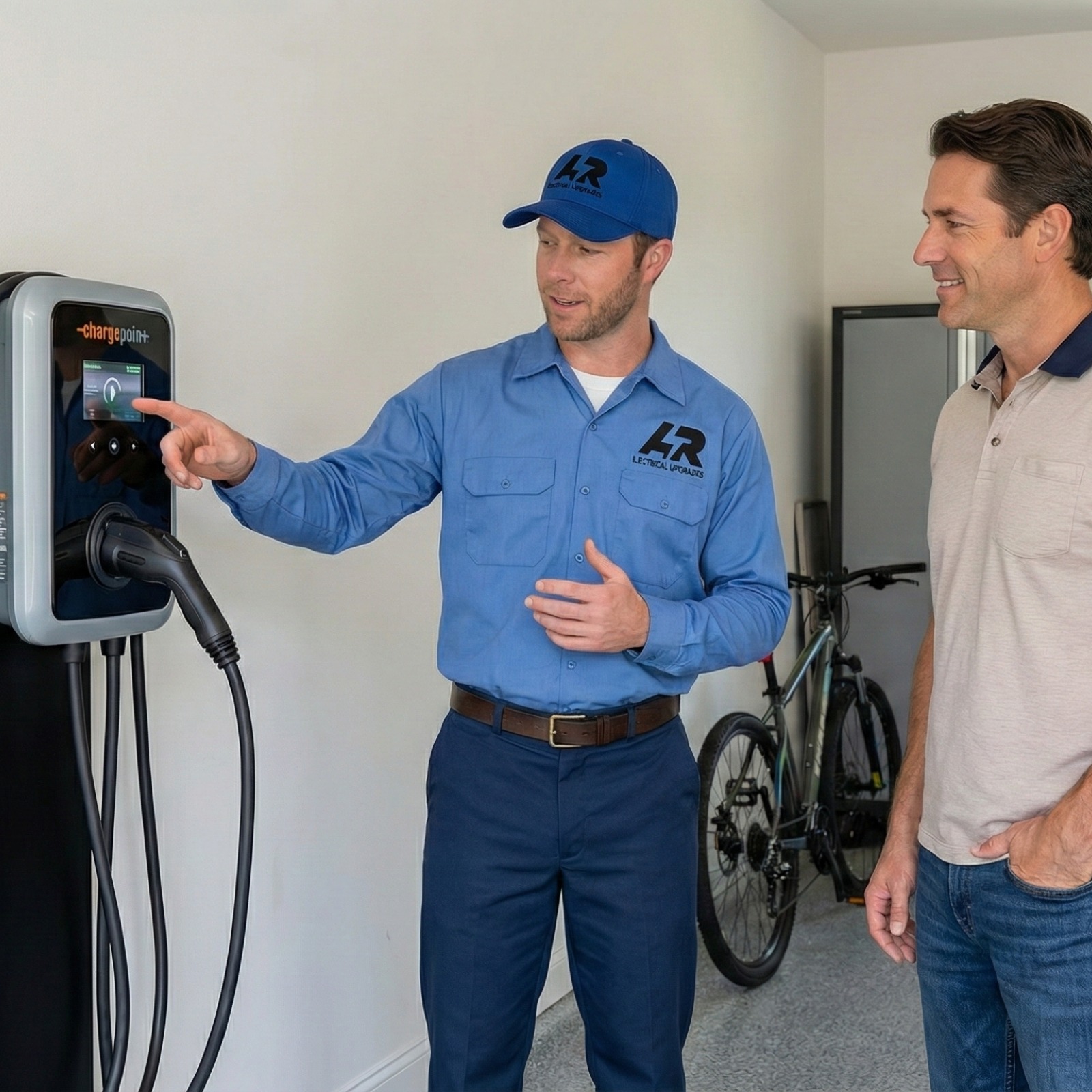
EV charger installation for South Florida homes

Every EV charger installation starts with a home electrical inspection to confirm safety, capacity, and compatibility.

EV Charger installation

When you need an EV Charger inspection

Your situation tells you what comes next.

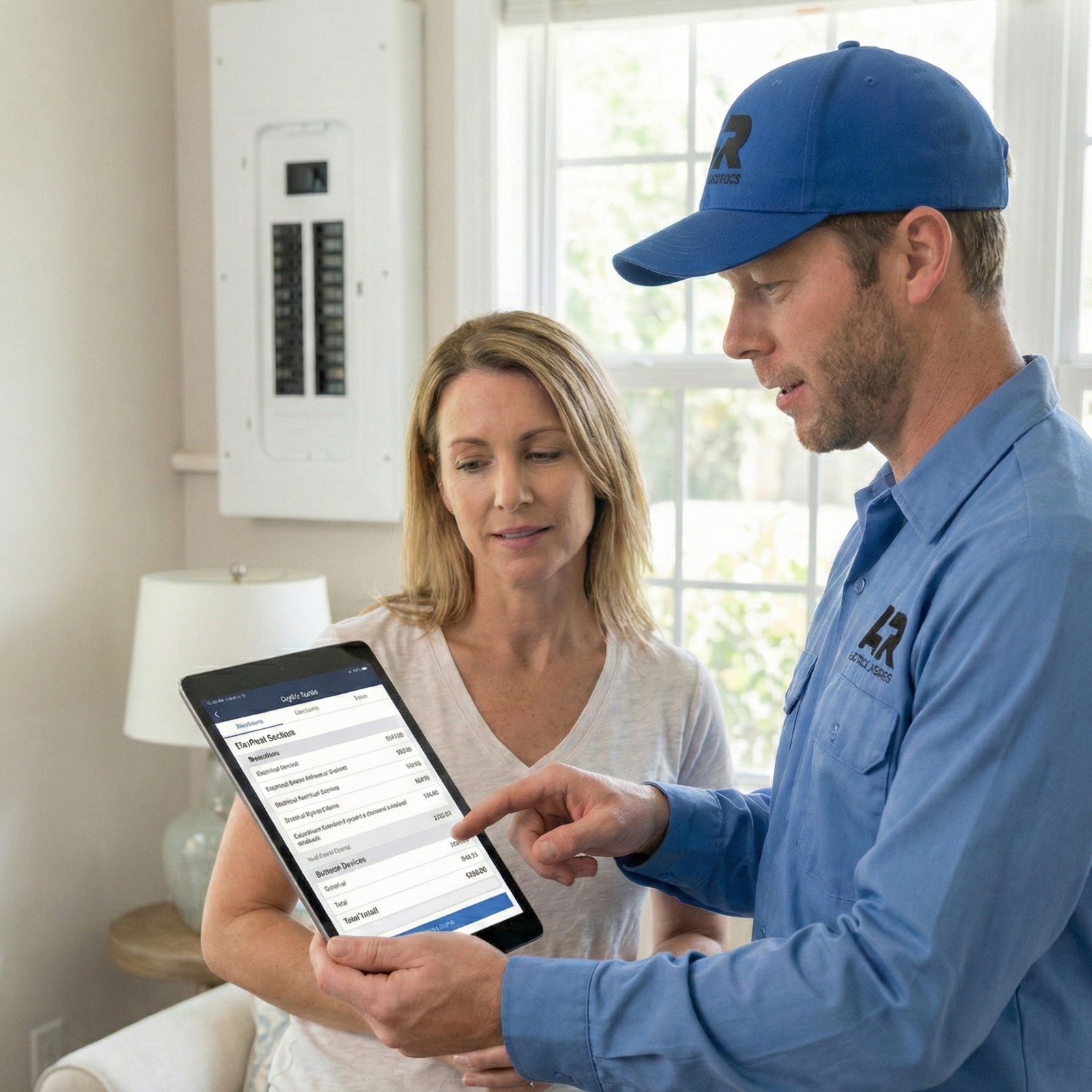
Electrical Panel Inspection review by AR electrical technician

You’re purchasing an electric vehicle

Before installation, confirm service capacity, load calculations, and dedicated circuit requirements to ensure safe Level 2 charging at home.

Panel's Level 2 charger support is unknow

An inspection verifies amperage rating, breaker space availability, and NEC compliance for 240V EVSE installation.

The panel is old or heavily loaded

Older or near-capacity panels may require load balancing, sub-panel additions, or service upgrades to support EV charging safely.

Your HOA or city requires permits

Many South Florida jurisdictions mandate permits, inspections, and utility coordination for residential EV charger installations.

Electrical Panel Inspection review by AR electrical technician

You’re purchasing an electric vehicle

Before installation, confirm service capacity, load calculations, and dedicated circuit requirements to ensure safe Level 2 charging at home.

Panel's Level 2 charger support is unknow

An inspection verifies amperage rating, breaker space availability, and NEC compliance for 240V EVSE installation.

The panel is old or heavily loaded

Older or near-capacity panels may require load balancing, sub-panel additions, or service upgrades to support EV charging safely.

Your HOA or city requires permits

Many South Florida jurisdictions mandate permits, inspections, and utility coordination for residential EV charger installations.

What installing a home EV charger involves

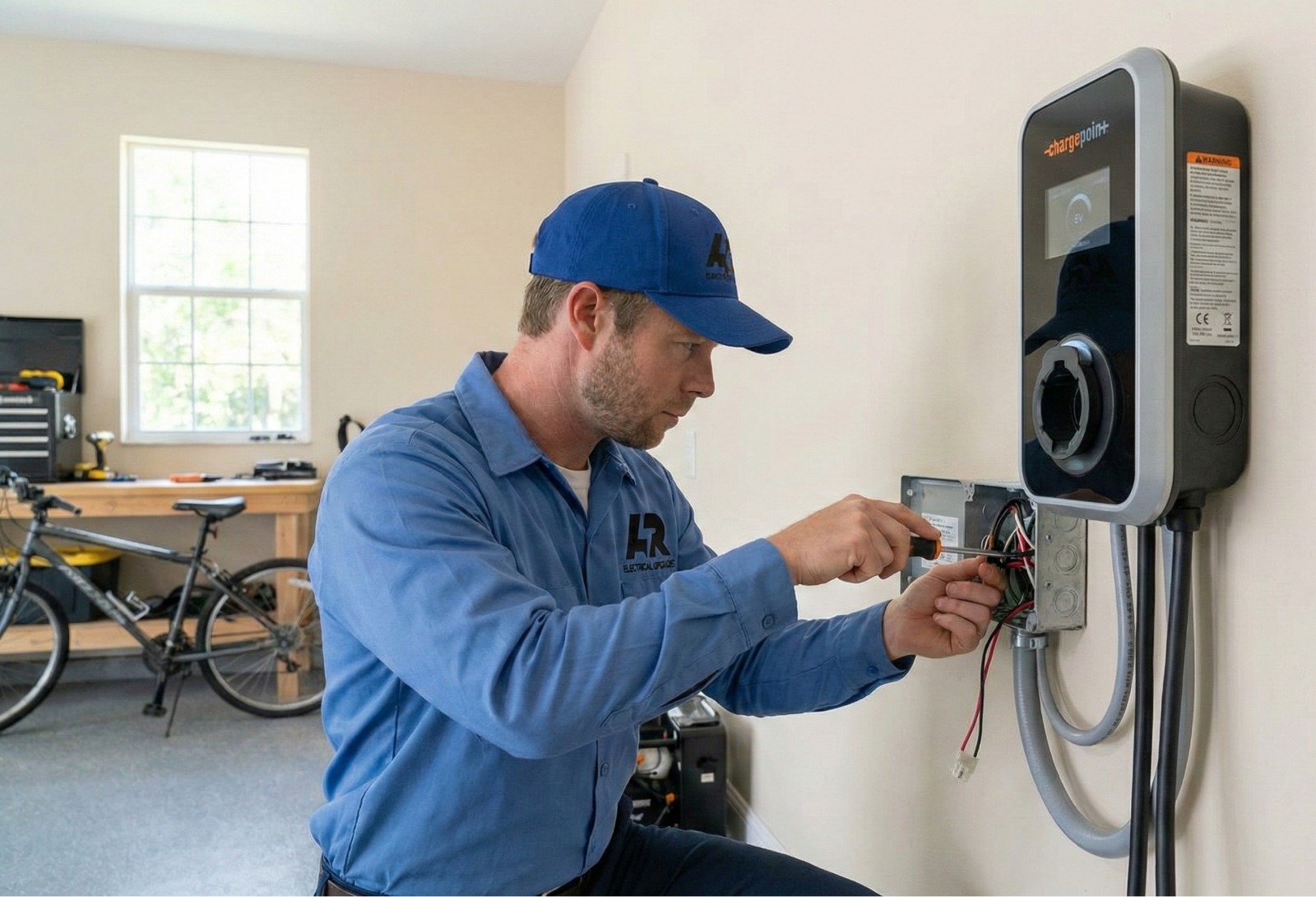
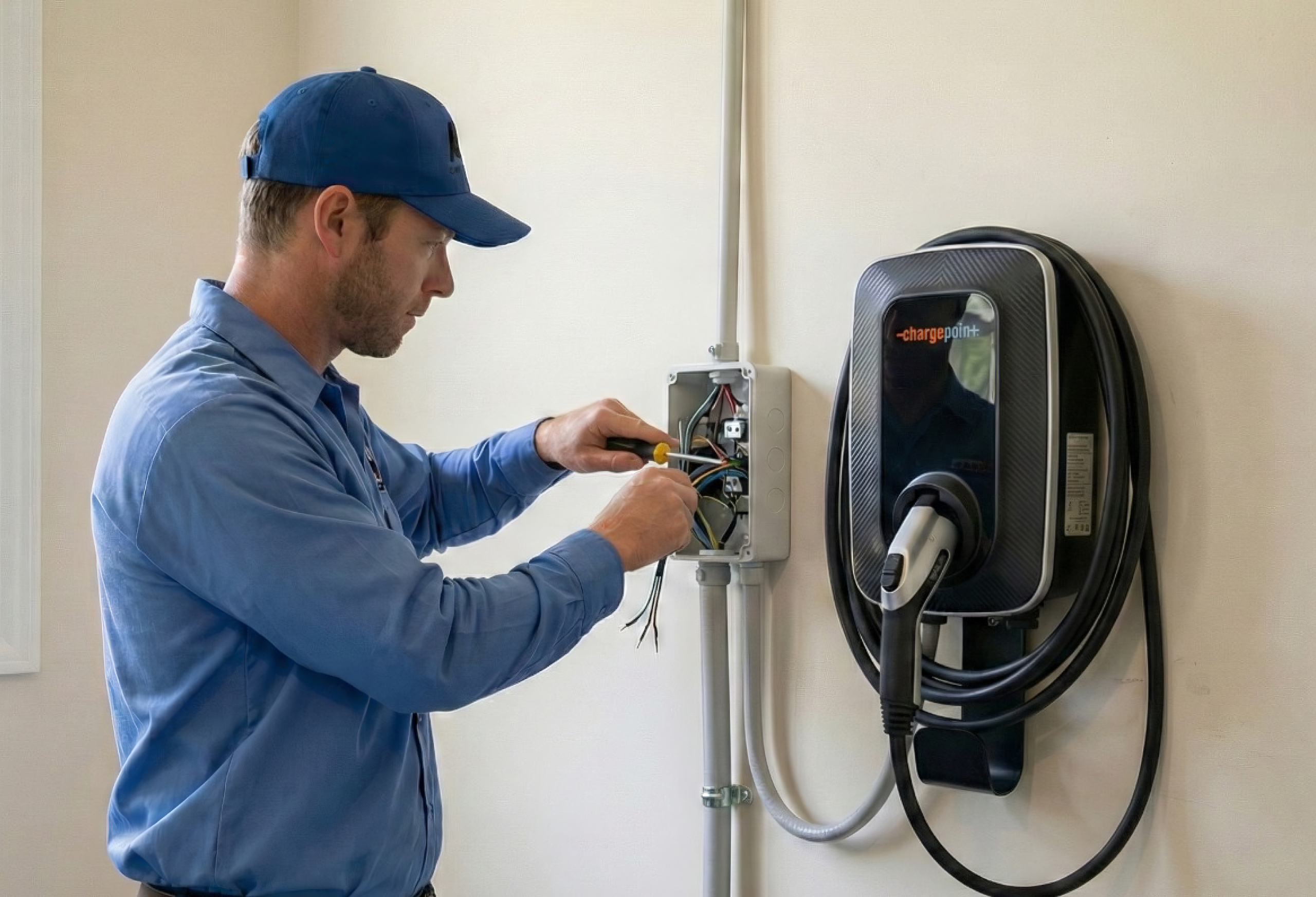
A EV charger is more than a box on your wall.

EV Charger installation

Level 2 chargers need proper circuit capacity

A 240V Level 2 EVSE requires a dedicated breaker, correct wire gauge, and verified load calculations to prevent overheating and voltage drop.

Panel upgrades happen when needed

If service capacity is limited, a panel upgrade or sub-panel installation may be required to safely support continuous EV charging loads.

Location matters for convenience and safety

Charger placement affects cable reach, weather exposure, ventilation, and NEC clearance requirements inside garages or exterior walls.

Permits and inspections ensure compliance

Most jurisdictions require electrical permits, plan review, and final inspection to confirm NEC compliance, proper grounding, and safe EV charger operation.

Home charging transforms how you live with your EV

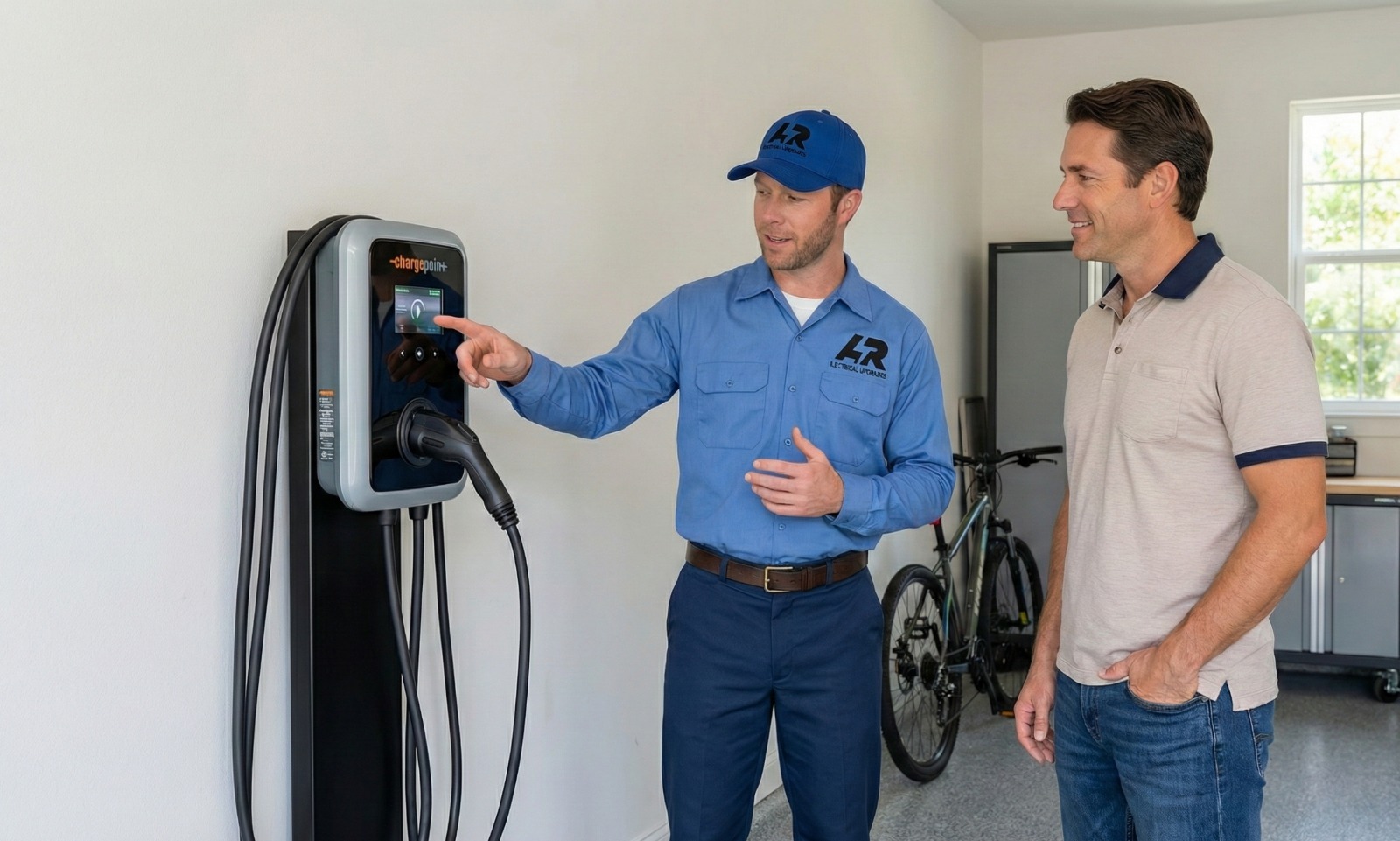
Home EV charging means no more detours to public stations. You wake up to a full battery every morning and cut your fuel costs in half.​

EV Charger installation client review

Charge overnight while you sleep soundly

No more planning around charging stations. Your car is ready when you are, every single day.

Cut electricity costs compared to gas

Home charging costs less than half of what you'd spend at the pump. Over time, the savings add up fast.

Your panel can handle the load safely

Wake up each morning to a fully charged battery. No more planning your day around public charging stations or waiting in line.

Add long-term value to your home

A professionally installed Level 2 charger adds resale appeal, supports future buyers, and positions your home for the growing shift toward electric vehicles.

Charge overnight while you sleep soundly

No more planning around charging stations. Your car is ready when you are, every single day.

Cut electricity costs compared to gas

Home charging costs less than half of what you'd spend at the pump. Over time, the savings add up fast.

Your panel can handle the load safely

Wake up each morning to a fully charged battery. No more planning your day around public charging stations or waiting in line.

Add long-term value to your home

A professionally installed Level 2 charger adds resale appeal, supports future buyers, and positions your home for the growing shift toward electric vehicles.

EV charger levels explained

Understand which charging option fits your home and driving habits.

Level 1 charging (120V outlet)

Plugs into a standard 120V household receptacle with no additional wiring. Charging is slow, typically adding 3–5 miles of range per hour, making it better suited for short daily drives or plug-in hybrids.

Level 2 charging (240V dedicated)

Uses a dedicated 240V breaker and properly sized wiring, similar to an electric dryer circuit. Most homeowners choose this option because it delivers 20–30 miles of range per hour and fully recharges overnight.

Level 3 charging (DC fast charging)

Designed for commercial stations and highway corridors. These high-voltage DC systems can reach 80% charge in about 30 minutes but require utility-scale infrastructure and are not compatible with residential installation.

EV Charger installation process

We arrive on time, work efficiently, and leave your home clean. 

Day one - Initial assessment begins

Our inspector examines your panel’s age, condition, and current load. We check for code violations, safety hazards, and capacity issues. This takes about 20 minutes.


Day two - Quote based on facts

We provide a detailed estimate for any work needed. No surprises. No hidden fees. Just honest pricing based on your home’s actual requirements.


Day three - Installation and permits

Once approved, we handle permits, scheduling, and the upgrade itself. We coordinate with local authorities and ensure everything passes final inspection.

Day one - Initial assessment begins

Our inspector examines your panel’s age, condition, and current load. We check for code violations, safety hazards, and capacity issues. This takes about 20 minutes.

Day two - Quote based on facts

We provide a detailed estimate for any work needed. No surprises. No hidden fees. Just honest pricing based on your home’s actual requirements.
 

Day three - Installation and permits

Once approved, we handle permits, scheduling, and the upgrade itself. We coordinate with local authorities and ensure everything passes final inspection.

Where we work

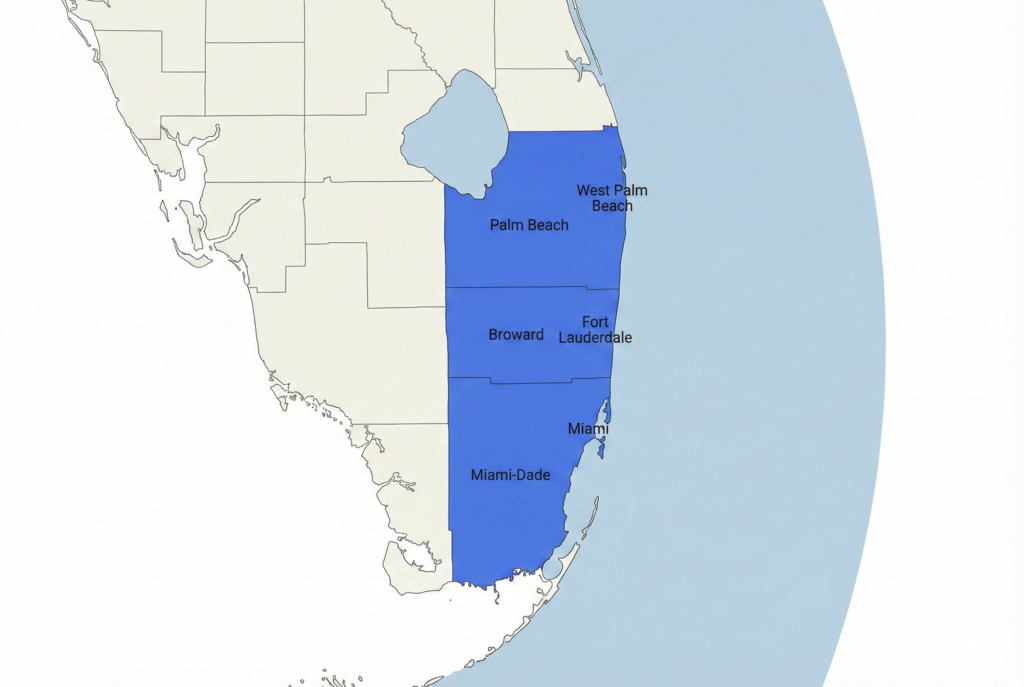
Our services are limited to residential properties within our South Florida service area.​

Broward County

Fort Lauderdale , Pembroke Pines, Hollywood, Coral Springs, Plantation, Sunrise, Weston, Davie, Deerfield Beach, Pompano Beach, Miramar, Tamarac, Margate, Coconut Creek, Dania Beach

Miami-Dade County

Miami, Hialeah, Miami Gardens, Miami Beach, Coral Gables, Doral, Homestead, North Miami, North Miami Beach, Aventura, South Miami, West Miami.

Palm Beach County

West Palm Beach, Boca Raton, Delray Beach, Boynton Beach, Palm Beach Gardens, Wellington, Jupiter.

AR Electrical service zone cover map

Where we work

Our services are limited to residential properties within our South Florida service area.​

Broward County

Fort Lauderdale , Pembroke Pines, Hollywood, Coral Springs, Plantation, Sunrise, Weston, Davie, Deerfield Beach, Pompano Beach, Miramar, Tamarac, Margate, Coconut Creek, Dania Beach

Miami-Dade County

Miami, Hialeah, Miami Gardens, Miami Beach, Coral Gables, Doral, Homestead, North Miami, North Miami Beach, Aventura, South Miami, West Miami.

Palm Beach County

West Palm Beach, Boca Raton, Delray Beach, Boynton Beach, Palm Beach Gardens, Wellington, Jupiter.

AR Electrical service zone cover map

FAQ

Answers to what homeowners ask us most often.

What is an EV charger and do I need one at home?

An EV charger is a device that safely delivers electricity from your electrical panel to your electric vehicle.

While you can use a standard wall outlet, a dedicated EV charger:

  • Charges your vehicle significantly faster

  • Provides a safer, more stable connection

  • Is designed for long-term daily use

  • Increases convenience and property value

For most homeowners, installing a Level 2 EV charger is the most practical solution.

What type of EV charger should I install?

Most residential installations use a Level 2 EV charger.

A Level 2 EV charger:

  • Runs on 240 volts

  • Charges much faster than a standard 120-volt outlet

  • Typically adds 20 to 40 miles of range per hour

The right EV charger depends on your vehicle, driving habits, and available electrical capacity.

Do I need an electrical panel inspection before installing an EV charger?

Yes.

Before installing an EV charger, an electrician must:

  • Perform a load calculation

  • Verify available capacity in your electrical panel

  • Determine if a panel upgrade is required

  • Identify the safest installation location

An inspection ensures your system can handle the additional demand without overloading.

Will I need to upgrade my electrical panel to install an EV charger?

It depends on your current panel capacity.

You may need an upgrade if:

  • You have a 100-amp panel

  • Your panel is already near maximum load

  • You are adding other high-demand equipment

The inspection determines whether your existing electrical panel can support the EV charger safely.


How long does EV charger installation take?

Most EV charger installations are completed in one day.

The timeline depends on:

  • Distance from the electrical panel

  • Electrical panel capacity

  • Permit requirements

  • Whether upgrades are needed

Your electrician will explain the full scope before starting the work.

Do I need a permit to install an EV charger?

In most cases, yes.

EV charger installations typically require:

  • An electrical permit

  • Compliance with local code

  • A final inspection

Your contractor handles the permitting process to ensure everything is approved and compliant.

Where should my EV charger be installed?

The best location depends on:

  • Parking layout

  • Distance to the electrical panel

  • Weather exposure

  • Vehicle charging port location

Installations are commonly done in garages, carports, or exterior walls with proper weather-rated equipment.

Can I install an EV charger outdoors?

Yes.

Many EV chargers are rated for outdoor use and can be installed on exterior walls. Proper weatherproofing and code-compliant wiring are essential for safety and durability.

How much does EV charger installation cost?

The cost varies based on:

  • Electrical panel capacity

  • Wiring distance

  • Mounting location

  • Permit requirements

  • Whether a panel upgrade is needed

After the inspection, you receive a clear estimate outlining the recommended solution.

Is installing an EV charger safe?

Yes, when installed by a licensed electrician.

Professional installation ensures:

  • Proper circuit sizing

  • Correct breaker protection

  • Safe grounding

  • Code compliance

Improper installation can create fire and shock hazards, which is why an inspection and licensed installation are critical.

Does installing an EV charger increase home value?

In many cases, yes.

As electric vehicles become more common, a professionally installed EV charger can:

  • Improve resale appeal

  • Make your home more future-ready

  • Attract EV-owning buyers

It is considered a practical infrastructure upgrade for modern homes.

Schedule Your Inspection or Service Request

Fast, licensed, and code-compliant electrical solutions. 

Contact Form Demo

Schedule Your Inspection or Service Request

Fast, licensed, and code-compliant electrical solutions. 

Contact Form Demo
Scroll to Top